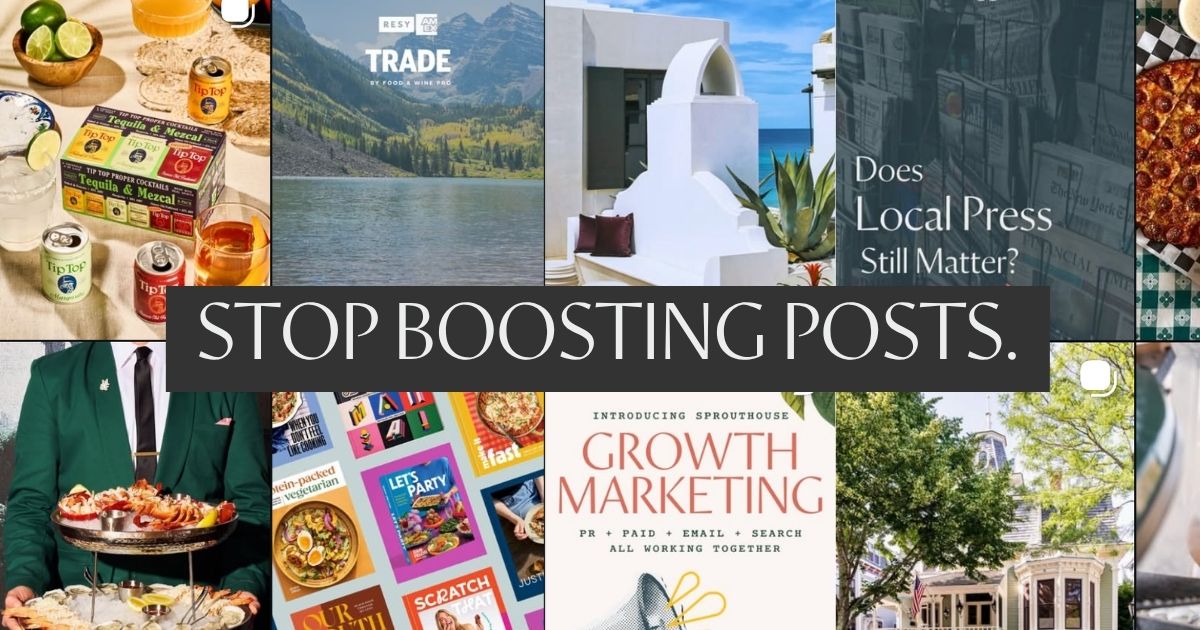
When it comes to growth marketing, we ask every hotel client about what their social media strategy look like. Their answers are usually variations of the same story: content planning happens maybe a week out, maybe less. Posts are usually about what’s going on at the property right now, but there’s rarely a narrative arc that tells the story of the place. And there’s almost never a purpose behind what guests see and when they see it.
Then there’s the paid strategy side where people seem to have even less of a strategy. Best case we’ve seen is that a property decides to put money behind a popular post when bookings are slow. There’s no campaign objective, no defined audience, no KPIs. Just a budget, a boost button, and a hope that something moves.
Eventually, and inevitably, the same question surfaces: is this working?
Without an objective, there’s nothing to measure. Without something to measure, there’s no way to learn. And without learning, the cycle repeats itself.
Content Planning Is Only Half the Job
Before we talk about paid social, it’s worth addressing the organic side, because the two are connected more than most hotels realize.
An always-on content calendar is a strategic tool. When you plan your posts at least 30 days out, you can build a narrative across your feed. You can sequence posts intentionally—introduce a new experience, build anticipation around a seasonal offer, and follow up with social proof from recent guests. Each post does a job to support your larger story.
Planned content is also usually better content. When you wait to decide what to post until you need to get something up, you’re making creative decisions under pressure. Contrast that with a plan you’ve made in advance: your images are great because you’ve had time to make sure they’re great, your caption is thoughtful and keyword rich, and every post in your grid reflects the experience your hotel is selling.
Planning makes it possible (and easier) to show up consistently on social media with compelling content.
The Boost Button is Not a Strategy
Boosting a post from Instagram or Facebook is the most basic form of paid social. You pick a budget, choose a vague audience, and pay to show your content to more people. It takes two minutes and feels productive.
But if you haven’t set up a Meta Business Suite account, you don’t have access to the tools that make paid social actually work for you: custom audiences built from website visitors, lookalike audiences modeled on your best guests, conversion-optimized campaigns with real objectives, and meaningful reporting that goes beyond likes and reach.
Meta Business Suites already has the tools to amplify your content to strangers who have no context for who you are or why they should book with you.
Paid Social for Hotels, the Right Way
A successful social media campaign starts with a specific and measurable objective—something like driving visitors to your booking page, capturing email addresses from people who have already visited your site, or reaching travelers who are actively researching trips to your area.
Everything about your campaign works in service of your objective: the visual, the caption, the audience targeting, the landing page, the follow-up. Each piece connects to the next and works on achieving your goal.
A clear goal empowers you to unlock Meta’s advertising tools’ full capabilities. Custom audiences let you target people who have already visited your website. Lookalike audiences let you find new prospects who share characteristics with your best existing guests. Retargeting lets you follow up with people who browsed your site but didn’t book. And none of these options are available when you’re just boosting from your phone.
According to Meta, campaigns optimized for conversions consistently outperform boosted posts on cost per result. The gap isn’t always dramatic at small budgets, but it compounds as your spend increases.
Small, Smart Tests
One of the most common misconceptions about paid social is that it takes big budgets to see results. Here’s the truth: your budget doesn’t matter, it’s the intention you put behind your money that actually matters.A boosted post at $50 gets you some reach. A smartly built campaign at $500 can land bookings. The real difference between these options is the “why” behind your spend.
For hotels exploring their first structured campaigns—without knowing your specific goals and issues—we recommend beginning with one objective, one audience, and two or three creative variations. Run your campaign for long enough to gather real data. Learn what resonates with your audience and what gets them to take action, and build from there. The goal in these early stages is to understand what works so you know what to scale when you’re ready to commit more money to the project.
The Question You Should Be Asking
“Is it working?” is the right question, but you can only truly answer if you’ve defined what “working” looks like before you started spending.
Are you trying to drive direct bookings? Grow your email list? Build awareness in a new feeder market? Each of those objectives requires a different campaign structure, different creative, and different metrics. Picking the most popular post and putting money behind it during a slow month is a reaction, not a strategy.
The hotels getting the most out of paid social aren’t necessarily the ones with the biggest budgets. They’re the ones who planned their content in advance, built campaigns with clear objectives, and created a feedback loop that gets smarter every month.
That’s not complicated, but it does require making a decision to stop improvising.
For more about how we can help structure and grow your social media plan, please visit our Growth Marketing page.
Related Articles: